Summary
Choose a narrow concept, write what you know from memory, and explain it in everyday language to locate parts that remain unclear.
Return to the original material where your explanation falters, find concrete examples, and revise before trying to explain the concept aloud again.
Apply the technique selectively to important or confusing ideas, using short learning blocks and a searchable collection of explanations for later review.
Ever try to explain something you thought you understood, only to realize it didn’t make sense halfway through?
That’s exactly what Richard Feynman paid attention to. His method was about making ideas clear, not just memorizing them.
We often confuse knowing with recognizing. Studies show people retain just 10 to 20 percent from reading or listening, but up to 90 percent when they teach it.
The Feynman Technique helps you slow down and test your understanding by explaining it out loud.
This guide shows how it works, why it helps, and how to use it in your daily routine.
What Is the Feynman Technique?

The Feynman Technique is a four-step learning method developed by Richard Feynman, a Nobel Prize winning physicist known for making complex topics feel intuitive. His approach was built on a simple idea. If you can’t explain something clearly, you don’t really understand it.
The technique isn’t about repeating definitions or memorizing jargon. It’s about translating what you’ve learned into your own words and spotting where your understanding breaks down.
Here’s how it works at a high level:
Choose a concept and write everything you know about it
Try to explain it as if teaching a child or a beginner
Identify gaps in your explanation and return to the material
Refine and simplify your explanation
This process surfaces confusion and replaces it with real clarity. Instead of just reviewing, you’re rebuilding. You teach yourself by teaching out loud. That’s what makes the method so effective.
Step-by-Step Breakdown

The Feynman Technique isn’t complex. But it does require you to slow down, challenge your assumptions, and test your thinking instead of just collecting more information. It’s less about how much time you spend learning and more about how clearly you can explain what you’ve learned. Each step builds deeper understanding by forcing you to clarify, not cram.
Here’s how to put it into practice:
Step 1: Choose a Concept and Write What You Know
Pick one concept; something small and specific enough to explain in a few minutes
Write out everything you currently know about it, without checking any notes or resources
Be honest about gaps or uncertainty; the goal is to map your real understanding, not your ideal version
Farnam Street suggests color-coding your notes to flag what feels strong versus shaky. For example: green = confident, yellow = needs review, red = unclear
Keep this low-pressure. You’re not testing yourself. You’re surfacing what’s real
Step 2: Explain It in Simple Language
Pretend you’re teaching a curious middle-schooler, or someone brand new to the topic
Use everyday words and analogies. No jargon, no shortcuts
If your explanation gets vague or you start relying on buzzwords, stop. That’s where you need to go back and strengthen your thinking
Farnam Street calls this “the ultimate test of clarity.” A flashcard maker can help you put this into practice by encouraging you to rewrite complex ideas in your own simple words, one card at a time.
In programming, this is similar to rubber duck debugging; just explaining something out loud often reveals where your logic breaks down
Step 3: Reflect and Refine
Go back to the parts you struggled with and re-study the original material
Look for real examples or use cases to help anchor abstract concepts
Rewrite your explanation, stripping away unnecessary complexity
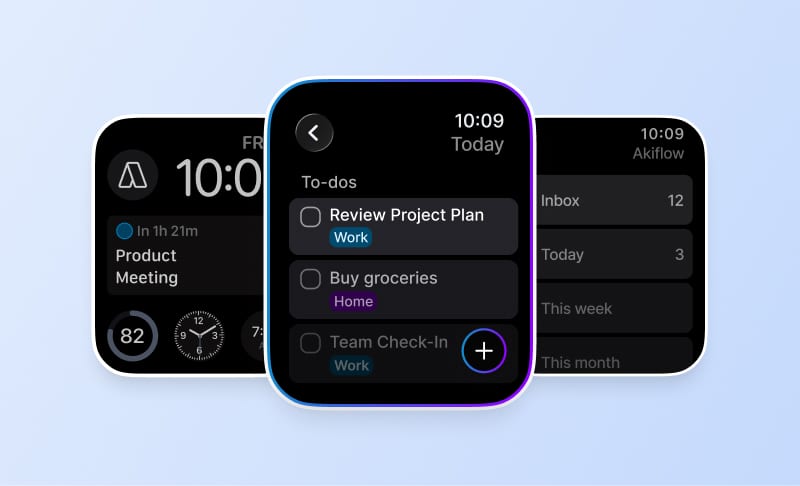
If you’re using Akiflow, break this step into subtasks like “Research why X works” or “Find real-world analogy for Y.” That turns confusion into a clear next action
Step 4: Teach or Test It Out Loud
Teach the concept to a peer, a team member, or even an inanimate object.
Say it out loud, without notes, and pay attention to where you pause or backtrack
WIRED reports in a 2025 piece that “Verbalizing ideas activates retrieval and error correction in ways silent review cannot”
This final step gives you a real feedback loop, either from others or from hearing yourself struggle to say something clearly
When you can teach it smoothly, without hesitation, you’re not just informed. You’ve internalized it.
Practical Tips for Applying It in Daily Work

The Feynman Technique is powerful, but like any tool, it works best when used with intent and flexibility. Once you understand the core steps, the next move is making it fit your day-to-day reality; tight schedules, shifting priorities, and high cognitive demands.
Here are five practical ways to make it work without forcing it:
Use it selectively
Apply the technique to concepts that matter for long-term thinking, decision-making, or high-stakes communication
Don’t try to “Feynman” everything. Focus on ideas that feel slippery, foundational, or repeatedly misunderstood
As Scott Young puts it, “You don’t need to explain everything. Just the parts that are holding you back”
Schedule learning in small blocks
Instead of saving it for a full hour of free time (which rarely comes), block 15 to 20 minutes for explanation work
Akiflow users often batch learning tasks in focus slots during lower-energy parts of the day
Use time blocking not just for deep work, but for deep learning too
Use structure to reduce friction
Create a repeatable task template like:
Concept title
Raw notes from memory
Explanation draft
Gaps to revisit
Final summary
This removes decision fatigue and makes the process easier to return to when you’re context switching
Build a “teaching vault”
Save your best final explanations somewhere searchable. Notion, Google Docs, or right inside Akiflow’s task notes
Review them weekly or monthly as spaced repetition
This turns your learning history into a personal knowledge base that gets stronger over time
Pair it with real-world feedback
Look for opportunities to explain your understanding during meetings, client calls, or team onboarding
The goal isn’t to sound smart. It’s to verify your clarity under real conditions
Friction is feedback. If someone asks a follow-up question you can’t answer smoothly, that’s data worth revisiting
Why It Works

The Feynman Technique engages specific mental processes that have been widely studied in cognitive science. It works not because it simplifies things but because it pushes your brain to do the hard part of learning, thinking.
Here’s what makes it effective according to recent research.
It introduces productive difficulty
The effort required to explain, revise, and teach a concept creates what scientists call desirable difficulty
Research published in Trends in Cognitive Sciences shows that material learned under mild challenge is retained longer than material absorbed passively
That extra friction strengthens memory and builds deeper understanding
It reinforces retrieval over review
Explaining something from memory is a form of retrieval practice
A 2025 study from the Journal of Applied Research in Memory and Cognition found that learners using retrieval techniques performed 31 percent better on long-term recall tests than those using re-reading strategies
Feynman turns each explanation into an informal, high-value memory test
It improves metacognitive accuracy
When you try to explain and fail, you become aware of what you don’t know
This ability to self-diagnose gaps is called metacognitive awareness
A study on chemistry learners at the University of Michigan in 2025 showed that students who practiced structured reflection were significantly better at troubleshooting and applying concepts on exams
It supports spaced reinforcement
The process naturally invites you to revisit and refine your explanation over time
This aligns with the spacing effect, a principle that states learning is stronger when spread out over intervals
A 2025 paper in Memory & Cognition confirmed that spaced review improves both retention and application across multiple domains
It activates physical and verbal encoding
Teaching out loud taps into the enactment effect; the idea that doing something, not just thinking about it, improves recall
According to cognitive research summarized by the APA, learners who verbalized concepts during study sessions remembered more details and retained them longer than silent learners
Saying it out loud is not just symbolic. It changes what your brain remembers
These mechanisms work together to turn explanation into a high-leverage learning strategy. It’s not about memorizing faster. It’s about thinking better.
Integrate the Technique into Your Workflow Using Akiflow
The Feynman Technique is simple to use but easy to forget in the rush of daily work. That’s where Akiflow comes in. By turning each step into trackable tasks and time blocks, you can build learning into your schedule without losing focus on your priorities.
Here’s how to make it part of your workflow:
Capture learning tasks on the fly
Whenever a confusing topic or new concept pops up, capture it as a task in Akiflow
Label it with a tag like “To explain” or “Feynman task”
This gives you a backlog of concepts to work through when you have time to think deeply
Time block short learning sessions
Block 15 to 30 minute windows in your calendar for focused explanation
Title the block clearly, for example “Clarify pricing logic model” or “Teach analytics funnel to self”
Treat these blocks like real meetings to protect them from distractions
Break learning into actionable subtasks
Use subtasks in Akiflow to walk through each phase of the Feynman process
Example subtasks:
Write what I know about client onboarding flow
Explain it like I am teaching an intern
Identify what is unclear
Refine and re-explain out loud
Get peer feedback
This makes learning structured, not vague or overwhelming
Archive and revisit final explanations
Save your polished explanations in a notes app or Akiflow task comments
Tag completed tasks for review during slow weeks or planning sessions
Over time, this becomes a personal knowledge library you can refer back to or even teach from
By pairing the Feynman Technique with Akiflow, learning becomes a visible, actionable part of your system. You are not just collecting knowledge. You are building clarity and depth into your calendar.
Wrapping Up
The Feynman Technique works because it cuts through the noise. It helps you slow down, explain clearly, and spot the edges of your understanding; something most of us don’t do often enough.
You don’t need more content. You need more clarity. And with the right system in place, you can make that part of your daily workflow.
Akiflow helps by giving you the structure to turn learning into action. Whether you’re explaining a technical concept, preparing for a high-stakes meeting, or just trying to remember what you read last week, capturing it and blocking time to teach it back makes the difference.
Try scheduling one concept to explain this week. Start small, stay consistent, and build clarity over time.
Want to see how Akiflow makes this easier? Try it free and turn your learning into something you can actually use.
Frequently Asked Questions
How narrow should my first learning topic be?
Choose one concept that is small and specific enough to explain in a few minutes. Write what you currently know without checking notes or resources, and mark uncertainty honestly. This first pass records your present understanding so you can see what needs attention during the next stages.
What should I notice while explaining the idea?
Use everyday words and examples as though speaking to a beginner. Pay attention to vague phrases, buzzwords, pauses or backtracking. Those are places to investigate further. Return to the material and strengthen the explanation instead of using complicated wording to cover a part you cannot yet explain clearly.
How do I work on a gap after I find it?
Go back to the part of the original material you struggled with, then look for a real example or use case. Rewrite the explanation with unnecessary complexity removed, and try saying it aloud again without notes. A peer’s questions can give you another reason to revisit an unclear point.
Should I use this technique for everything I read?
Use it selectively for foundational ideas, repeatedly misunderstood concepts or topics important to decisions and communication. You do not need to explain every detail this way. A short fifteen-to-twenty-minute learning block is one suggested starting format, rather than waiting for a large amount of free time.
What should I keep after a learning session?
Keep a record of the concept, raw notes from memory, explanation draft, gaps to revisit and final summary. Save polished explanations somewhere searchable and review them weekly or monthly. That gives you a collection to return to when you need to explain a topic again or revisit uncertain details.