Summary
Define work goals as outcomes, then identify the recurring actions that support them. Track those actions separately from the final results you want.
Work backward from each goal to estimate the weekly effort required, and reserve calendar time for preparation, execution and follow-up.
Review progress and obstacles weekly, keep updates visible to your team and revise the plan as responsibilities or priorities change.
Most professionals set goals in January with genuine enthusiasm. By March, those same goals are buried under daily firefighting, endless meetings, and a backlog that never shrinks.
The problem isn’t ambition or commitment. It’s the gap between setting goals and building the daily systems that makes them achievable. Research shows that only 8% of professionals achieve their annual work goals. This is not because the goals are wrong, but because they lack an execution framework.
This guide cuts through the motivational fluff. You’ll learn a practical 10-step process for setting work goals that integrate seamlessly into your existing workflow, even when your schedule feels impossible.
Why Most Work Goals Fail Before They Begin
Before you set another goal, you need to understand why the last batch didn’t make it past Q1.
Traditional goal-setting advice focuses almost entirely on the what and why. Set SMART goals. Align with company objectives. Track your progress. All valid, but incomplete.
The missing piece is the execution layer, the daily decisions, task prioritization, and time allocation that transform aspirations into outcomes. When your goals live in a separate document from your calendar and task list, they become decorative rather than directional.
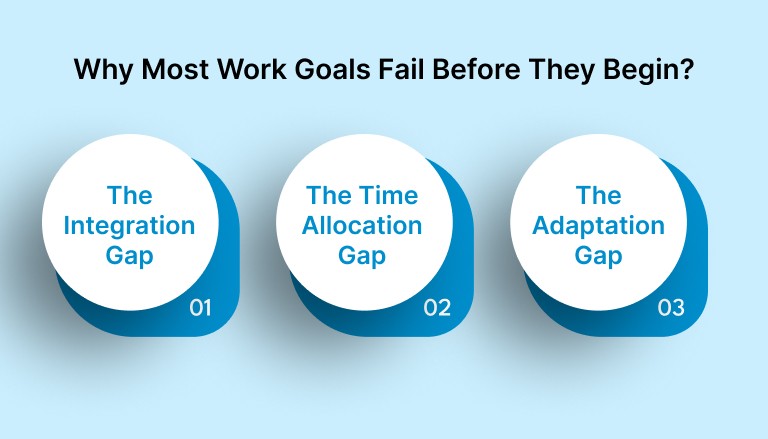
Three critical gaps doom most work goals:
The Integration Gap: Your goals exist in a performance review document while your actual work happens across Slack, email, project management tools, and calendar apps. There’s no connective tissue between strategic intent and daily action.
The Time Allocation Gap: You set ambitious targets without blocking time to work on them. Important goal-related tasks lose to urgent requests because urgency always wins when time isn’t protected.
The Adaptation Gap: Work is dynamic. Priorities shift, emergencies arise, and new opportunities appear. Rigid annual goals can’t accommodate this reality, so they become irrelevant rather than guiding.
The solution isn’t better goal statements. It’s building an execution system that connects goals to daily workflows.
Also Read: Goal-Setting Frameworks Every Professional Should Know
The 10-Step Process to Set Work Goals That Actually Drive Results
Now that you understand why goals fail, let’s build the system that makes them succeed. This isn’t theory. It’s the exact process that separates professionals who achieve ambitious targets from those who perpetually start over each January.
Step 1: Audit Your Current Reality Before You Dream Bigger
Before setting new goals, understand where your time actually goes. Track one full week without changing behavior. What percentage of your time advances meaningful outcomes versus reacting to incoming requests?
Action: Review your calendar for the past month. Categorize time as strategic work, reactive work, or administrative tasks. If less than 30% of the work is strategic, your goal-setting process needs to include time-protection mechanisms.
Step 2: Define Outcome-Based Goals, Not Activity-Based Goals
Here’s where most goal-setting goes sideways. People confuse motion with progress.
Bad goal: “Send 50 outreach emails per week.” Good goal: “Generate 15 qualified leads per quarter through strategic partnerships.”
The difference? One measures busyness, the other measures impact. Outcome-based goals force you to think about what actually moves the needle, not just what keeps you visibly occupied.
Define 3-5 primary goals maximum. More than that, when everything becomes a priority, nothing does.
Step 3: Connect Goals to Leading Indicators
Every goal has lagging indicators (final results) and leading indicators (activities that predict results). Identify both.
If your goal is “increase team productivity by 20%,” your leading indicators might be “reduce average meeting length by 15 minutes” or “implement weekly planning sessions.”
Why this matters: Leading indicators give you weekly feedback. Lagging indicators only tell you if you succeeded at the end, when it’s too late to adjust.
Step 4: Reverse-Engineer the Path
Work backward from your end goal. If you need to close 12 new clients by year-end, and your close rate is 25%, you need 48 qualified opportunities. If it takes 10 discovery calls to generate one qualified opportunity, you need 480 discovery calls.
Suddenly, your annual goal has a clear weekly requirement: 10 discovery calls per week. This is the translation layer most goal-setting frameworks skip.
Step 5: Block Time Before Tasks Pile Up
Here’s where execution begins. Take your reverse-engineered requirements and block time on your calendar before reactive work fills every available slot.
If you need 10 discovery calls per week, block time for call prep, the calls themselves, and follow-up. Treat these blocks as non-negotiable appointments with your goals.
Time-blocking isn’t about rigid schedules. It’s about intentional allocation. When unexpected work appears (and it will), you can make informed trade-offs rather than defaulting to whatever screams loudest.
Step 6: Build a Centralized Execution Dashboard
Your goals, related tasks, and time blocks need to live in one place. When these elements are scattered across tools, the friction of context-switching kills momentum.
A centralized system lets you see the relationship between today’s tasks and long-term objectives. When someone requests your time, you can evaluate it against what you’ve already committed to your goals.
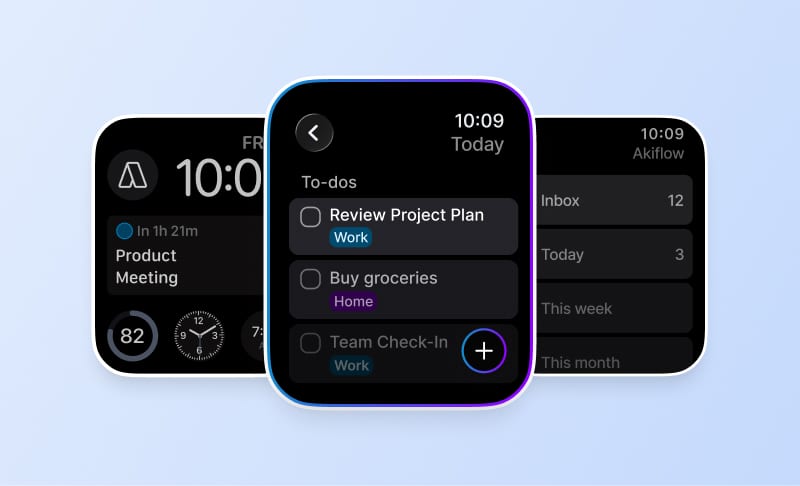
Productivity platforms like Akiflow solve this integration problem by pulling tasks from multiple sources into a single dashboard alongside your calendar, making it easier to protect goal-related work from daily noise.
Step 7: Create Weekly Recalibration Rituals
Set aside 30 minutes every Friday for goal review. Answer three questions:
What progress did I make toward my leading indicators this week?
What blocked progress, and can I remove that obstacle?
What’s my primary goal-related focus for next week?
This weekly checkpoint prevents you from discovering in December that you’re nowhere near your annual targets. Small adjustments compound over time.
Step 8: Protect Deep Work Windows
Some goals require sustained focus, not fragmented attention. Writing a strategic document, designing a new process, or analyzing complex data demands uninterrupted thinking time.
Identify which of your goals require deep work and schedule 90-120 minute blocks with no meetings, notifications, or interruptions. Treat these sessions as sacred.
The quality of work produced in three hours of deep focus often exceeds what happens in a full week of distracted effort.
Step 9: Build Accountability Without Bureaucracy
Share your goals with one person, a peer, manager, or accountability partner. Schedule a 15-minute monthly check-in where you report progress and discuss obstacles.
External accountability transforms goals from private intentions to public commitments. Knowing someone will ask about your progress creates positive pressure without the overhead of formal reporting structures.
Step 10: Separate Goals from Identity
Your goals are experiments, not promises. Some will succeed. Others will reveal that the path you chose doesn’t work, or that the goal itself was based on incomplete information. That’s not failure, it’s learning.
When you separate your self-worth from goal achievement, you can adjust course without ego getting in the way. The goal is progress and learning, not perfection.
Also Read: How to Manage Work and Personal Calendars
Common Goal-Setting Pitfalls (And How to Avoid Them)
You’ve got the process. Now, let’s make sure you don’t trip over blow-up, even the best-laid plans. These pitfalls catch experienced professionals just as often as newcomers. Here’s how you can avoid them:
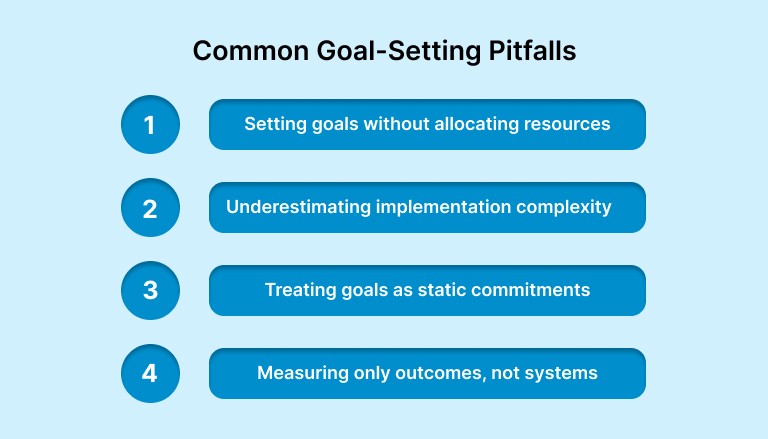
Setting goals without allocating resources. A goal without dedicated time and attention is a wish. If you’re not willing to say “no” to something else, you’re not serious about the goal.
Underestimating implementation complexity. Most people overestimate what they can accomplish in three months and underestimate what’s possible in a year. Build buffer time into your plans.
Treating goals as static commitments. Business conditions change. What made sense in January might be irrelevant by June. Rigidity isn’t a virtue; it’s stubbornness.
Measuring only outcomes, not systems. Focus on the quality of your execution system. If you follow your process consistently, results follow.
Avoid these traps, and you’re already ahead of 90% of your competition. However, goal execution looks different when your team is distributed. Visibility without surveillance becomes crucial.
Also Read: How Productive People Plan Their Day (And What You Can Copy)
How to Make Goal Setting Work When Your Team Is Scattered Across Time Zones
Remote work changed everything about goal execution. The old playbook of status meetings and physical presence doesn’t translate to distributed teams. Here’s what actually works when your colleagues are spread across continents.
Async goal updates replace status meetings. Use shared documents where team members update progress on their own schedule. This respects different time zones and work styles while maintaining alignment.
Public commitments matter more when you’re not physically present. When someone shares their quarterly goals in a team channel, it creates natural accountability without micromanagement.
The advantage of remote work for goal achievement? Fewer interruptions and more control over your schedule. The challenge? Discipline to use that autonomy effectively.
Also Read: 12 Healthy Habits for Successful Remote Work at Home
Final Words!
The difference between professionals who achieve ambitious goals and those who don’t isn’t talent or opportunity. It’s the presence of an execution system that connects strategic intent to daily action.
When your goals, tasks, and calendar exist in one unified view, you can make real-time decisions about where your limited time and energy should go. You can see when goal-related work is getting crowded out by reactive demands and adjust before the week is gone.
Akiflow‘s integrated approach to task and time management helps busy professionals bridge this execution gap, consolidating tasks from multiple tools, enabling effective time-blocking, and reducing the context-switching that kills focus.
Ready to stop setting goals and start achieving them? Try Akiflow and build the execution system your ambitions deserve.
Frequently Asked Questions
What’s the difference between OKRs and SMART goals—which should I use?
SMART goals work best for individual contributors with clearly defined outputs. OKRs suit teams and organizations needing alignment across functions. If you’re operating solo or with high autonomy, use SMART goals. If coordinating across departments, OKRs provide better scaffolding for cascading priorities. Don’t overcomplicate. Pick the framework that matches your context.
What’s the ideal number of work goals to set at one time?
Stick to 3-5 major goals maximum. Any more dilutes your focus and makes everything a priority, which effectively means nothing is. If you’re managing a team, limit yourself to 2-3 personal goals and 2-3 team goals. Quality of execution beats quantity of intentions every time.
How do I set goals when I don’t have clear metrics or KPIs in my role?
Create proxy metrics that indicate progress. If you’re building team culture (hard to measure), track participation in team events, pulse survey scores, or voluntary collaboration instances. If you are developing a strategy, measure stakeholder meetings completed, frameworks created, or decisions influenced. Imperfect metrics beat no metrics.
Can I use AI tools to help set and track my work goals?
Yes, but with guardrails. AI can help break large goals into tasks, suggest timelines, and identify dependencies. However, AI can’t determine what matters most to your career or company—that’s human judgment. Use AI for execution support (task generation, scheduling optimization), not strategic direction (which goals to pursue).
Frequently Asked Questions
What is the difference between a work goal and an activity target?
A work goal names a result, while an activity target describes work intended to help produce it. For example, generating qualified leads is an outcome; sending outreach emails is an activity. Track both so you can see whether completing the planned work is actually moving you toward the desired result.
How do you turn an annual goal into weekly actions?
Work backward from the outcome to the activities required, then divide that workload into manageable weekly commitments. For a sales goal, that might mean estimating the opportunities and calls needed using your conversion assumptions. Treat the numbers as planning estimates and revisit them as you learn what progress actually requires.
What should you put on the calendar for a work goal?
Schedule the actions behind the outcome, including preparation and follow-up, not just the main event. A call-based goal needs time for call prep, the calls themselves and the work afterward. Compare those commitments with the rest of your week so the goal has time allocated to it.
What should a weekly goal review cover?
Ask what progress you made on the activities supporting your goal, what blocked that progress and what needs attention next week. Use the answers to adjust your plan or remove an obstacle. The review is a chance to change how you work, not simply record whether the target was met.
How can remote teams keep goal progress visible?
Use shared documents where people can update progress on their own schedule, alongside clear team commitments. Keep accountability lightweight with a regular check-in with a peer or manager. As priorities change, revisit the goals and supporting work rather than assuming the original plan must remain unchanged throughout the quarter.