Summary
Define future work goals around the responsibility and impact you want, then identify gaps in technical expertise, business understanding and communication.
Translate career direction into annual capability goals with a business problem and visible outcome, supported by recurring actions in your weekly schedule.
Communicate progress through problem, action and result; review development monthly and reconsider goal relevance quarterly as business priorities change.
Most professionals work hard, but few work with clear direction.
You complete tasks, meet deadlines, handle problems, and stay busy. Yet after a year, many people feel their careers haven’t moved forward meaningfully. The issue isn’t effort; it’s the absence of a clear, future-oriented framework that connects daily work to long-term progression.
Defining future goals at work is not about motivational ambition. It is about building capabilities, ownership, and impact that naturally lead to growth, trust, and advancement. Without that structure, work becomes reactive instead of developmental.
This guide explains how to define meaningful future goals at work and translate them into measurable, career-advancing progress.
Why Most People Struggle With Goal Setting at Work?
A common issue is confusion between outcomes and actions. People often say:
“I want a promotion.”
“I want to earn more.”
“I want leadership responsibilities.”
These outcomes are partly controlled by the organization. Progress depends on the underlying question:
What is your goal at work?
That question should define the level of responsibility and impact you want to grow into, not just the title you want to hold.
When this clarity is missing, work becomes task-focused rather than growth-focused.
How to Decide What My Goals Are at Work?
Not knowing your work goals doesn’t mean you lack ambition or drive. It usually means you’ve been busy delivering tasks, solving problems, and meeting expectations, but haven’t paused to ask what direction am I actually moving in?
Let’s look at the details.
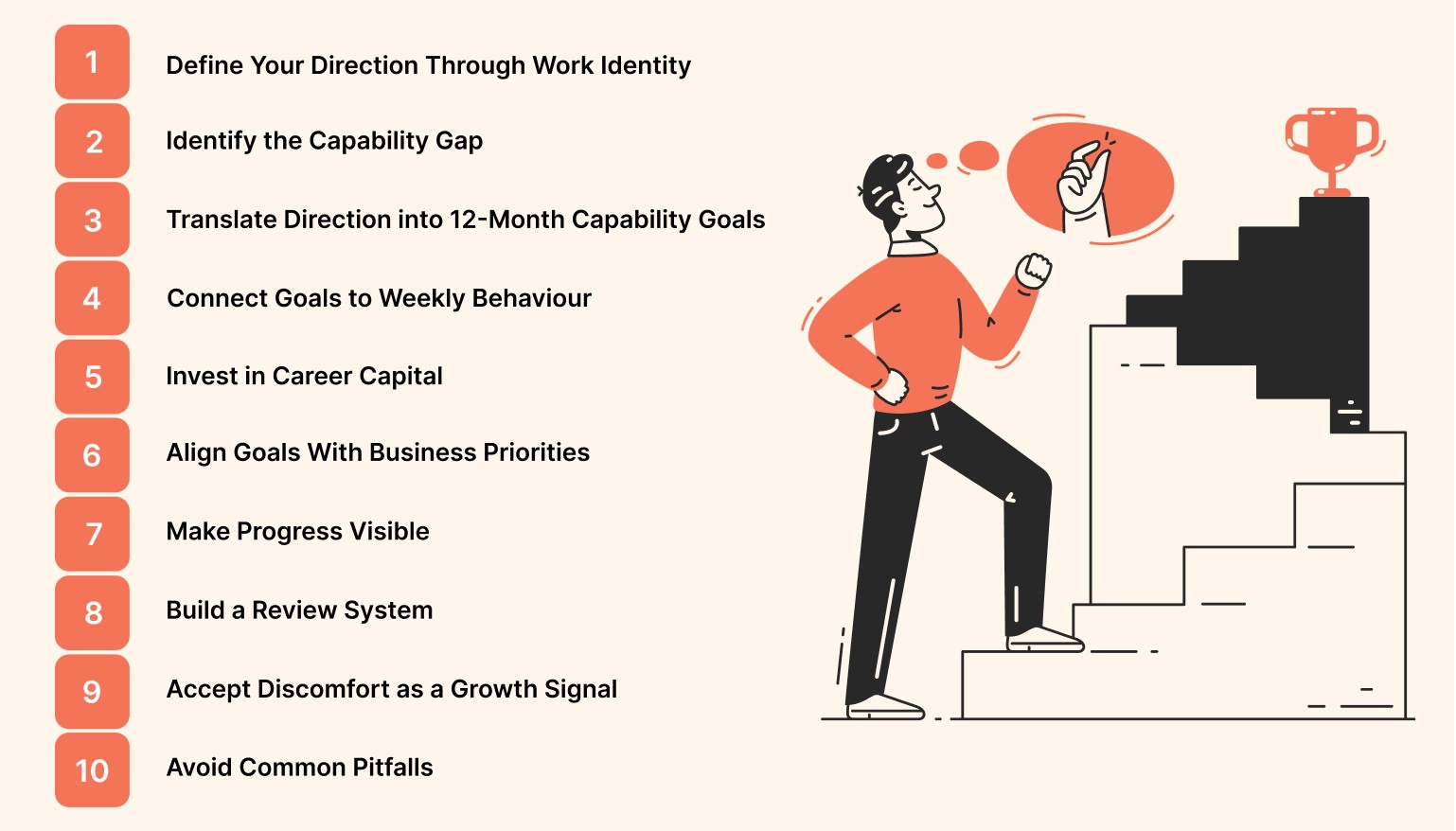
Step 1: Define Your Direction Through Work Identity
Start by clarifying what kind of work you want to be trusted with, not just what title you want.
Ask:
Do I want to make decisions or execute instructions?
Do I want to own outcomes or contribute tasks?
Do I want to influence strategy or operations?
Do I want to solve technical problems or business problems?
This defines your work identity and future trajectory. Career direction is about moving from:
Current Work | Future Work |
|---|---|
Task execution | Decision ownership |
Narrow scope | Broader impact |
Following processes | Designing processes |
Individual output | Cross-functional influence |
When you understand the nature of future responsibility, you can reverse-engineer the skills required.
Also Read: The 80:20 Rule: What Does It Mean for Work and Productivity?
Step 2: Identify the Capability Gap
Every higher-level role demands growth in three areas.
1. Functional or Technical Mastery
You must deepen your expertise in your domain. This includes tools, systems, methodologies, and problem-solving approaches.
2. Business Understanding
You need to understand how work affects:
Revenue
Costs
Risk
Customers
Operational efficiency
At higher levels, decisions are judged by business impact, not effort.
3. Influence and Communication
Growth requires the ability to:
Present ideas clearly
Align stakeholders
Explain trade-offs
Handle disagreement professionally
Most professionals over-invest in technical skills and under-invest in influence and business thinking. Future goals should address all three dimensions.
Step 3: Translate Direction into 12-Month Capability Goals
Long-term goals feel distant. Break them into capability milestones that can be developed within a year.
Weak goal:
“I want to move into a strategic role.”
Strong goal:
“I will lead two cross-functional initiatives involving analysis, decision-making, and stakeholder coordination.”
Effective 12-month goals include:
A skill to develop
A business problem to address
A visible outcome
They should change how you work, not just what you wish for.
Step 4: Connect Goals to Weekly Behaviour
Goals only produce results when converted into recurring actions.
Ask: What must I do consistently for this goal to become real?
Examples:
Goal | Weekly Behaviour |
|---|---|
Improve business understanding | Review performance metrics weekly |
Build leadership capability | Take ownership of meeting facilitation |
Strengthen presentation skills | Present updates instead of sending reports |
Deepen technical knowledge | Schedule focused learning time |
If growth activity is not scheduled, operational work will always take its place.
Goals don’t fail from lack of ambition; they fail from lack of scheduled time.
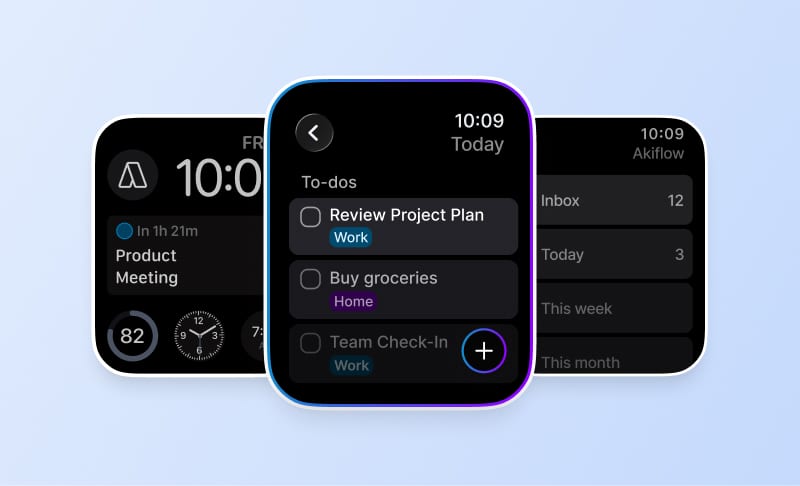
Tools like Akiflow help turn career intentions into calendar commitments, making it easier for growth work to actually happen.
Step 5: Invest in Career Capital
Not all work contributes equally to growth.
Operational work keeps processes running.
Career capital work increases your long-term value.
Career capital activities include:
Leading initiatives
Solving recurring inefficiencies
Automating manual tasks
Improving documentation
Standardizing processes
Building systems others rely on
These activities show initiative and increase your leverage within the organization.
Step 6: Align Goals With Business Priorities
Future goals accelerate when they intersect with business needs.
Ask your manager:
What risks are most critical this year?
Where does the team lose time or resources?
What projects will matter most in the next quarter?
Then frame your goal around solving those issues.
Example: Instead of “learn automation,” aim to automate a reporting workflow that consumes significant team time.
When personal growth creates business value, support and visibility increase naturally.
Step 7: Make Progress Visible
Performance and progression are not the same. Good work must be visible to influence career movement.
Focus on communicating outcomes, not effort.
Use this structure:
Problem → Action → Result
Example:
“We reduced reporting time from three days to one by standardizing inputs and automating data consolidation.”
This demonstrates the following capabilities:
Ownership
Problem-solving
Measurable impact
Consistent, concise updates build professional credibility.
Step 8: Build a Review System
Without regular review, even well-defined goals drift.
Monthly Review
What did I do this month that contributes to future goals?
What skill improved?
What impact did I create?
Quarterly Review
Are goals still relevant?
Did business priorities change?
Do I need to adjust direction?
This ensures effort remains aligned with evolving context.
Step 9: Accept Discomfort as a Growth Signal
Future goals involve work beyond your comfort zone.
Expect:
Slower performance initially
Increased feedback
Occasional mistakes
These are signs you are operating at a higher level of challenge. Avoiding discomfort leads to stagnation.
Step 10: Avoid Common Pitfalls
Too many goals
Focus on 3–4 meaningful areas.Mistaking busyness for growth
Volume of work does not equal progress.Waiting for permission
Act at the next level before receiving the title.Learning without application
Skills grow only through real use.
Using Work Systems to Support Goal Execution
Clear goals create direction, but execution depends on how work is organized day to day. Without a structured system, growth activities often get replaced by urgent operational tasks. Professionals who make consistent progress usually rely on integrated task and calendar workflows that help prioritise, schedule, and review commitments in one place.
Tools designed for structured planning, such as Akiflow, support this by turning intentions into visible, time-bound actions that fit within realistic workweeks.
A structured workflow system helps ensure career goals translate into consistent weekly execution.
How such tools support goal progress:
Bring tasks, priorities, and calendar events into one view
Help allocate dedicated time for development work
Reduce task overload by clarifying daily focus
Support weekly and monthly planning reviews
Make progress visible instead of assumed
Read More: How to Improve Time Management Skills in 2025: 5 Strategies That Actually Work
Indicators That Your Goals Are Working
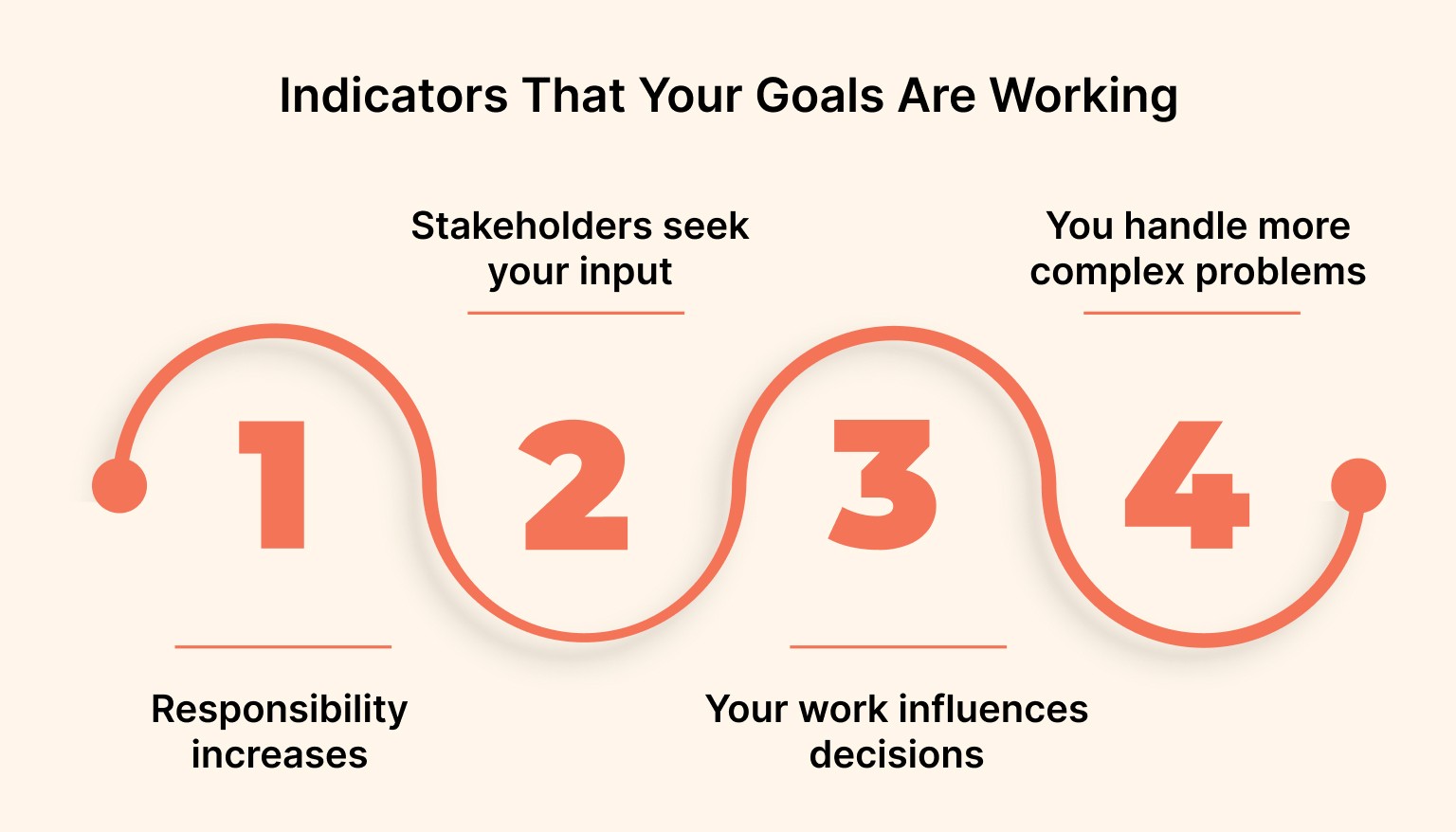
Work goals are effective only when they lead to visible professional progress, not just completed tasks. Real growth shows up in how others rely on you, the level of problems you handle, and the influence your work carries.
These indicators help you assess whether your goals are strengthening your role, expanding your capability, and moving your career in a meaningful direction.
Below are the key signs that your goals are producing results.
Responsibility increases
You are entrusted with broader tasks, higher-stakes work, or ownership that affects outcomes beyond your immediate scope.
Stakeholders seek your input
Colleagues, managers, or cross-functional teams begin consulting you before making decisions, indicating that your expertise and judgment are recognized.
Your work influences decisions
Your analysis, recommendations, or execution start shaping plans, priorities, or strategic direction rather than only supporting existing instructions.
You handle more complex problems
You are assigned issues that require deeper analysis, coordination, or independent judgment. Increased complexity is a strong sign of professional growth and trust.
Final Thoughts
Future goals at work are not abstract ambitions. They are practical decisions about the level of responsibility, impact, and capability you want to grow into. When goals are defined in terms of skills, business contribution, and ownership, daily work shifts from routine execution to career development. This approach creates steady progress instead of waiting for change to happen externally.
Achieving these goals depends less on motivation and more on structure. When growth activities are translated into weekly behaviours, reviewed regularly, and aligned with business needs, progress becomes visible and sustainable.
Plan your week with intention and use tools like Akiflow to turn career goals into scheduled, repeatable action
Frequently Asked Questions
How do you move from wanting a promotion to defining a useful work goal?
Describe the work you want to be trusted with, such as owning decisions, improving processes or influencing work across teams. Then identify the capabilities that responsibility requires. Promotions and pay are partly controlled by the organization, so a development goal should make the underlying skills and intended contribution explicit.
Which capability gaps should a development plan consider?
Look beyond technical expertise to business understanding and influence. Consider how your work affects revenue, costs, risk, customers or efficiency, alongside your ability to present ideas, align stakeholders and explain trade-offs. A plan can then address the demands of the responsibility you want, rather than concentrating only on tools or specialist knowledge.
What makes a 12-month capability goal concrete?
Include a skill to develop, a business problem to address and a visible outcome. For example, leading two cross-functional initiatives involving analysis and stakeholder coordination is more concrete than wanting a strategic role. Connect that goal to recurring weekly behavior, such as focused learning time or taking responsibility for meeting facilitation.
How can you align a personal development goal with team needs?
Ask your manager about important risks, places where the team loses time or resources, and projects that matter in the coming quarter. Frame the goal around one of those problems. For instance, improving a time-consuming reporting workflow gives a learning goal a specific business application rather than leaving it as an abstract ambition.
How should you communicate and review career-goal progress?
Use a problem, action and result structure to explain outcomes rather than only listing effort. Each month, review contributions to future goals, skills improved and impact created. Each quarter, check whether the goals remain relevant and whether business priorities require a change of direction. These are separate checks on progress and continued fit.