Summary
Run ideation as a repeatable workflow: time-box the session, define the problem and success criteria, and leave with a shortlist, owners, and next actions.
Separate divergence from convergence so you first generate many ideas without judgment, then cluster and prioritize them by impact, feasibility, and alignment with goals.
Turn top ideas into small experiments by setting a hypothesis, one primary metric, an owner, a 1 to 4 week timebox, and a scale, iterate, or kill decision.
In the modern corporate landscape, what sets market leaders apart from stagnant companies is their ability to consistently tap into collective intelligence. That happens when leaders use simple, repeatable workflows, not one-off bursts of inspiration. Many companies treat innovation like a sudden burst of inspiration, but the truth is, real growth comes from intentional, repeatable processes that turn creative ideas into strategic moves.
Effective leaders run structured ideation sessions that produce a shortlist of ideas, owners, and next actions. By setting clear boundaries and focusing on action, they avoid getting stuck in endless discussions and instead create a culture of fast experimentation. This approach ensures that ideas aren’t just talked about—they’re tested and refined, driving the organization forward.
In this post, you’ll learn the divergent, convergent framework and practical techniques to generate ideas, prioritize them, and move into execution.
Select specific techniques like Brainwriting or SCAMPER based on team size and goals.
Convert prioritized ideas into action by defining testable hypotheses and measurable success metrics.
Why Idea Generation Matters?
Effective idea generation helps teams move faster, align earlier, and make clearer decisions. When leaders encourage structured ideation, teams create stronger solutions, secure stakeholder support earlier, and build roadmaps based on shared understanding rather than assumptions.
Here are the main reasons why idea generation matters:
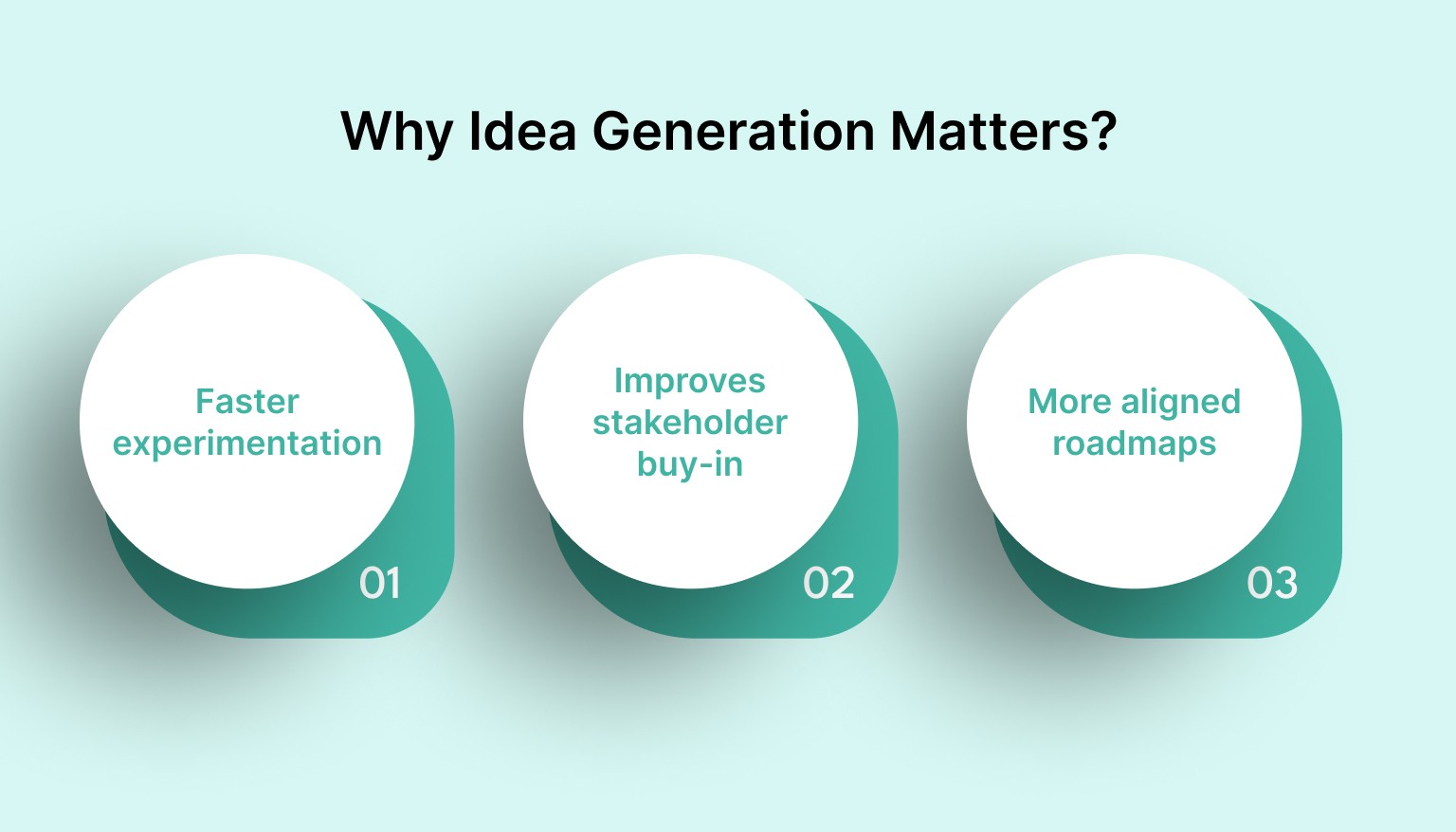
Faster experimentation: When teams produce multiple options early, they can test ideas quickly, learn sooner, and avoid spending weeks executing weak concepts that should have been filtered out.
Improves stakeholder buy-in: Involving team members and decision-makers in ideation can increase transparency and ownership, making approvals smoother and reducing resistance later.
More aligned roadmaps: Instead of reacting to urgency or opinions, teams prioritize ideas based on impact, feasibility, and strategic goals, resulting in clearer direction and better long-term outcomes.
Also Read: Why an All-in-One Digital Planner Works Better Than Multiple Apps
Before You Run a Session: Three Quick Rules
A successful idea generation session depends more on preparation than creativity. Setting clear boundaries and expectations helps teams stay focused, contribute equally, and leave the session with usable outcomes instead of scattered thoughts.
Here are three quick rules to follow before you begin:
Keep the session time-boxed and goal-oriented: Define how long the session will run and what problem you are solving. Clear constraints prevent overthinking and help teams generate ideas with purpose.
Invite the right mix of people: Include both doers and decision makers. Doers bring practical insight, while decision makers provide direction and ensure ideas can move forward.
Define success criteria upfront: Clarify what a good outcome looks like, whether it is a shortlist of ideas, a prioritized set of concepts, or inputs for experimentation.
Before starting, prepare a simple facilitation checklist:
Assign a facilitator to guide the discussion
Choose a timekeeper to maintain pace
Designate a notetaker to capture ideas and decisions
Decide where outcomes will be documented and shared
The Divergent-Convergent Framework
Effective idea generation follows a simple two-phase approach. Teams first expand their thinking to explore many possibilities, then narrow their focus to select the most valuable ideas to pursue. This structure prevents premature decisions while keeping sessions outcome-driven.
Here is how the divergent-convergent framework works:
Divergent thinking: This phase focuses on generating as many ideas as possible without judgment. The goal is quantity over quality, encouraging creativity, new perspectives, and unexpected solutions.
Convergent thinking: In this phase, teams evaluate and refine ideas. Concepts are grouped, discussed, and prioritized based on impact, feasibility, and alignment with goals.
Use the techniques below to diverge creatively, then use the prioritization steps to pick what to test first.
To prevent great ideas from getting lost, capture outcomes in one place, assign owners, and schedule the next steps. A tool like Akiflow can help by bringing tasks and your calendar together, making follow-through easier.
Idea Generation Techniques for Teams and Leaders
Different challenges require different ideation methods. Some techniques are best for rapid creativity, while others help teams explore problems deeply or improve existing ideas. Using the right technique ensures sessions stay productive and inclusive.
Below are practical idea generation techniques leaders and teams can use in workshops, meetings, or remote sessions:
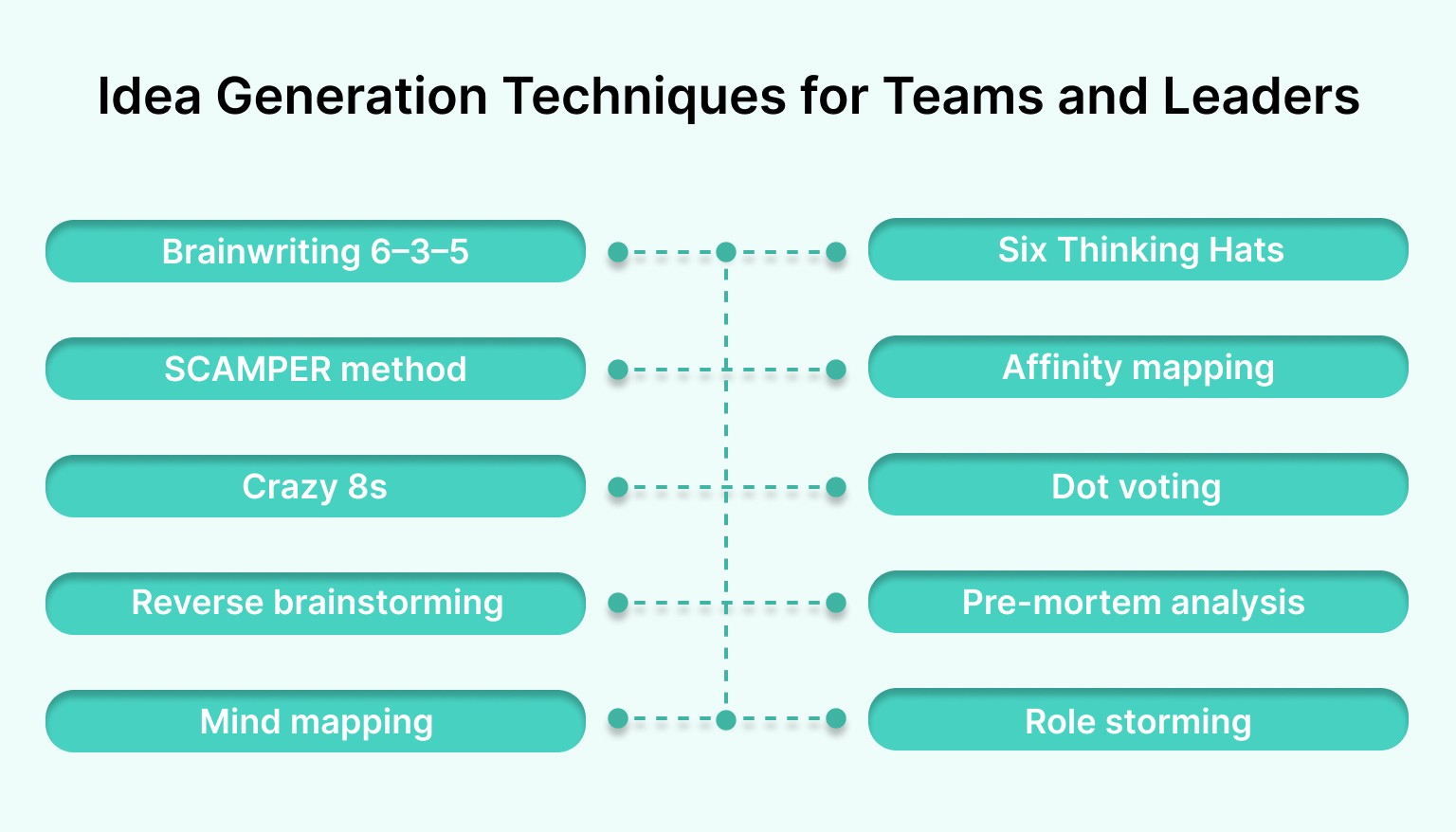
Brainwriting 6–3–5: Participants write ideas silently instead of speaking aloud. In the classic format, 6 people write 3 ideas in 5 minutes, then pass them along for the next round (adaptable to any group size).
SCAMPER method: This technique uses guided prompts such as substitute, combine, adapt, modify, eliminate, and reverse to improve existing products, processes, or workflows.
Crazy 8s: Team members sketch eight ideas in eight minutes. The strict time limit prevents overthinking and encourages fast, intuitive problem-solving.
Reverse brainstorming: Instead of asking how to solve a problem, teams ask how they could make it worse. These negative ideas are then flipped into actionable solutions.
Mind mapping: Ideas are built visually around a central problem. This method helps teams uncover patterns, connections, and opportunities that linear lists often miss.
Six Thinking Hats: Participants explore ideas from specific perspectives such as logic, emotion, risk, or creativity. This structure reduces bias and ensures balanced discussion.
Affinity mapping: Similar ideas are grouped into themes, helping teams identify patterns and focus areas before prioritization.
Dot voting: Team members vote on ideas using limited dots, allowing quick prioritization based on collective judgment.
Pre-mortem analysis: Teams imagine an idea has failed and work backward to identify risks and opportunities for improvement before execution.
Role storming: Participants generate ideas from the perspective of users, customers, or stakeholders to uncover insights beyond internal assumptions.
How to Choose the Right Technique?
Not every idea-generation method works in every situation. The right technique depends on your goal, team size, available time, and whether the session is remote or in person. Intentional choice helps teams stay focused and achieve clear outcomes.
Use the table below to select the most suitable technique for your session:
Goal | Team Size | Time Available | Remote Friendly | Best Output |
Generate many ideas quickly | 3 to 8 people | 15 to 30 minutes | Yes | Large volume of raw ideas |
Improve existing features or processes | 3 to 10 people | 30 to 45 minutes | Yes | Refined and expanded concepts |
Create visual concepts | 2 to 6 people | 10 to 20 minutes | Yes | Sketches and visual prototypes |
Explore risks and assumptions | 4 to 10 people | 30 to 60 minutes | Yes | Risk-aware ideas and improvements |
Organize scattered ideas | 3 to 12 people | 20 to 40 minutes | Yes | Clear themes and clusters |
Prioritize ideas for execution | 3 to 15 people | 15 to 30 minutes | Yes | Ranked and shortlisted ideas |
Align cross-functional teams | 5 to 12 people | 45 to 60 minutes | Yes | Shared direction and ownership |
When in doubt, start with a fast divergent technique to generate options, then use a convergent method to prioritize what to test. This combination ensures creativity without sacrificing clarity or momentum.
Also Read: Airtable Calendar: How It Works, How to Set It Up, and When to Use It
Sample 60 Minute Session Agenda
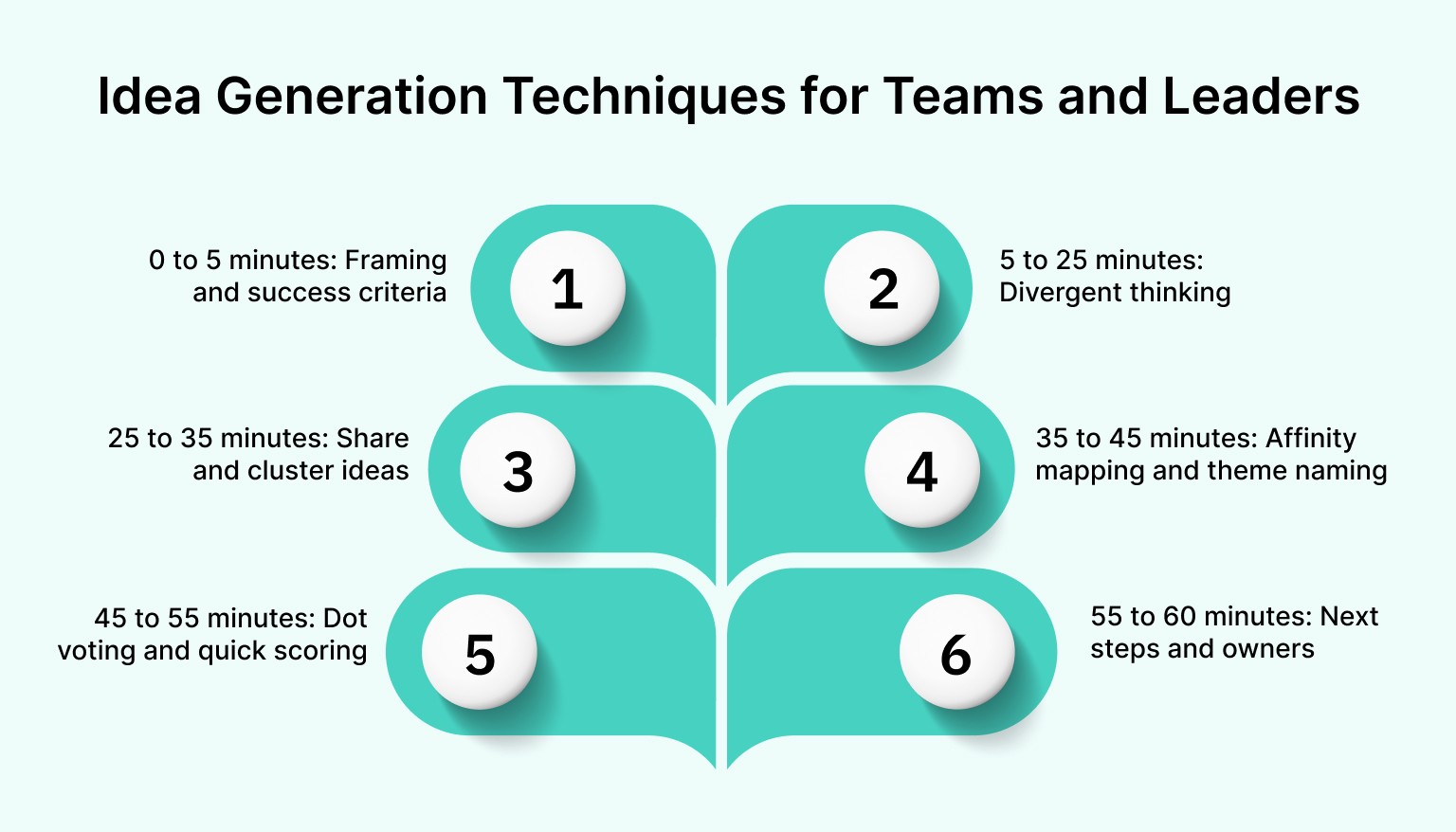
A clear agenda keeps idea generation sessions focused and productive. This 60-minute structure balances creativity with decision-making, helping teams move from open thinking to clear next steps without rushing or losing momentum.
Here is a simple copy-and-paste-ready agenda you can use:
0 to 5 minutes: Framing and success criteria
Clearly define the problem, explain the goal of the session, and outline what a successful outcome looks like.5 to 25 minutes: Divergent thinking
Use Brainwriting or Crazy 8s to generate ideas quickly. Encourage quantity over quality and avoid discussion or judgment.25 to 35 minutes: Share and cluster ideas
Review all ideas together and group similar ones to identify emerging patterns.35 to 45 minutes: Affinity mapping and theme naming
Organize clusters into clear themes and label them to create a shared understanding.45 to 55 minutes: Dot voting and quick scoring
Narrow focus by voting on ideas based on impact, feasibility, and alignment with goals.55 to 60 minutes: Next steps and owners
Decide which ideas move forward, assign owners, and clarify what happens after the session.
Turning Ideas into Action: Short Playbook
Ideas are only valuable when tested. This short playbook turns your top ideas into fast, measurable experiments so teams learn quickly and decide what to scale or stop.
Follow these steps to convert, run, and learn:
Pick the top three ideas: Use dot voting or weighted scoring to select three diverse bets. Choose a mix of low-effort/quick-win tests and one riskier, high-impact idea.
Set one primary metric and success criteria: Pick a single metric that shows progress and a numeric threshold that defines success. Secondary metrics can be tracked, but do not distract from the primary signal.
Assign an owner and timebox: Give each experiment a single owner and a strict timebox, typically 1 to 4 weeks. Clear ownership and a deadline force focus.
Design the smallest testable experiment: Build the minimum viable test that validates the hypothesis. Examples: landing page, prototype, concierge service, small A/B test, or 5 targeted user interviews.
Run the test and track results: Monitor the primary metric and capture qualitative feedback. Log daily or weekly updates so the team can spot trends and blockers early.
Log learnings and make a decision: At the end of the timebox, summarize the outcome, why it succeeded or failed, and the recommendation: scale, iterate, or kill. Record one concrete next step.
Share outcomes and update the roadmap: Publish a short experiment note to stakeholders, archive findings, and adjust priorities or roadmaps based on evidence.
Experiment template (copy-paste ready)
Hypothesis
Primary metric and success threshold
Owner
Timebox
Test method (MVP)
Results summary
Decision and next step
To make follow-through easier, use a system that captures outcomes, assigns owners, and schedules the work. Akiflow can help connect tasks to your calendar so experiments don’t fall through the cracks.
Remote Facilitation Toolkit and Resources
Running ideation remotely requires predictable tools, clear templates, and tight timeboxing. The right setup makes sessions inclusive, reduces friction, and ensures ideas move from the board into action.
Below are recommended tools, ready templates, and quick facilitation tips for remote teams.
Shared doc (Google Docs, Notion): Host the agenda, live notes, and the experiment template. Assign an owner so notes are captured and updated in real time.
Video conferencing (Zoom, Google Meet): Run the session, use breakout rooms for small-group work, and enable recording or live captions for accessibility and later reference.
Timers and pace-keeping tools (Online timer, built-in whiteboard timers): Enforce strict timeboxes for each activity to keep momentum and prevent overdiscussion.
Voting and prioritization tools (MURAL voting, Mentimeter, Polly): Run dot voting or weighted scoring quickly and transparently so the team can converge fast.
Prototyping and sketching (Figma, Excalidraw): Capture rapid visual concepts during Crazy 8s or design-focused sessions. Share links so reviewers can comment afterwards.
Async handoff (Akiflow): Turn follow-ups into assigned tasks, schedule them on the calendar, and keep action items visible alongside your day.
Pre-built templates to prepare: Session agenda, affinity mapping board, Crazy 8s frames, dot-voting sheet, and the experiment template (hypothesis, metric, owner, timebox). Share these before the session so participants arrive ready.
Quick facilitator tips: Send pre-work and the success criteria, call out roles at the start, use breakout rooms for parallel divergence, ask participants to contribute silently for the first 10 minutes, and end with a clear owner and next step.
Use this toolkit to remove logistical friction so the team can focus on idea quality and quick experiments.
Conclusion
Mastering idea generation is not about waiting for a moment of brilliance; it is about establishing a repeatable system that balances creative freedom with strategic discipline. By moving through structured divergent and convergent phases, leaders can eliminate the guesswork that often plagues innovation.
When teams shift from subjective opinions to evidence-based experimentation, they build roadmaps that are resilient, aligned, and primed for execution. To ensure these ideas move from the whiteboard to reality, seamless organization is essential. Use Akiflow to centralize your session outcomes, time-block your experiments, and turn brainstorming notes into actionable tasks.
Sign up today to streamline your workflow and ensure your team’s most ambitious ideas never fall through the cracks.
Frequently Asked Questions
How can a remote team start an ideation session?
Start with a silent contribution round, using brainwriting or quick sketches on a shared board. Give people a chance to record ideas before discussing them together. Then cluster related ideas and use voting against agreed criteria to create a shortlist, with owners and next actions for the ideas you decide to test.
How do you stop dominant personalities from taking over?
Use a silent start. Brainwriting works well because people write before anyone speaks, and a first ten-minute silent contribution block reinforces that pattern. Name a facilitator, timekeeper, and notetaker before you begin so the session keeps moving and discussion stays balanced instead of drifting toward the loudest person in the room.
How should you choose the group size for ideation?
Match the group to the purpose of the session. The guide uses three to eight people as a starting example for generating ideas quickly, and larger groups for some alignment activities. Decide who needs to contribute, how much time is available and how each person will participate before choosing the session format.
When should you run these sessions?
Run these sessions when you need direction before execution: at the start of a new project, during quarterly planning, or when the team hits a strategic roadblock. They are especially useful when you need multiple options early, because generating choices up front helps you test sooner, align earlier, and avoid spending weeks on weak concepts.
How do you choose between two strong ideas?
Choose between two strong ideas by scoring them against your success criteria, then pressure-test the front-runner with a pre-mortem or a smallest possible experiment. Compare impact, feasibility, strategic alignment, and manageable risk. If the scores are close, set one primary metric, give the test a single owner, and decide in advance whether you will scale, iterate, or kill it.